

Best necklace for strapless wedding dress: brides' guide
For most strapless wedding gowns, a short pendant or choker-style necklace that sits clearly above the bodice is the best choice. The single rule that bridal stylists return to again and again is the balance rule: match the boldness of your necklace with the embellishment on your dress. A heavily beaded or lace bodice calls for simple, understated jewellery. A clean, minimal gown opens the door to a statement bib or architectural piece.
Here is the quick-reference summary before the detail:
- Simple or plain gown: statement necklace, bib, or layered strands work well.
- Sweetheart neckline: pendant or layered chains that echo the curve; avoid chokers.
- Heavily embellished bodice: skip the necklace entirely; shift focus to earrings or hair jewellery.
- Straight-across strapless: choker or short collar echoes the horizontal line beautifully.
- Low-back gown: consider a lariat worn backward so the drop falls down the spine.
Table of Contents
- Which necklace style suits your strapless gown?
- How do you choose the right necklace for your dress?
- Necklace length guide: what fits a strapless neckline?
- How to pair your necklace with earrings and other accessories
- When should you skip the necklace altogether?
- Shop-ready picks from The Wedding Garter Australia
- Does your skin tone affect which metal to choose?
- What necklace material holds up on a wedding day?
- What should you budget for a bridal necklace?
- Key takeaways
- Style rules are a starting point, not a finish line
- Bridal jewellery for strapless gowns, curated and ready to ship
- Useful sources
- FAQ
Which necklace style suits your strapless gown?
Not every necklace works with every strapless silhouette. The table below maps each style to the necklines it flatters and the situations where it falls flat.
| Necklace type | Best neckline match | When to avoid |
|---|---|---|
| Choker (14–16 in) | Straight-across strapless | Sweetheart necklines; can visually shorten the neck |
| Short pendant / princess (16–18 in / 41–46 cm) | Sweetheart, straight-across | Very ornate bodices; pendant can disappear in beading |
| Matinee (20–22 in) | Deep-V strapless, open necklines | Structured corseted bodices; length may end at bodice edge |
| Bib / statement collar | Clean, minimal gowns | Any heavily embellished neckline |
| Y-drop / lariat | Sweetheart, deep-V | Stiff structured bodices; drop can shift |
| Layered strands | Straight-across, sweetheart | Ornate lace; too much visual noise |
| Pearl strand or choker | Ballgown, A-line, vintage lace | Ultra-modern minimalist gowns |
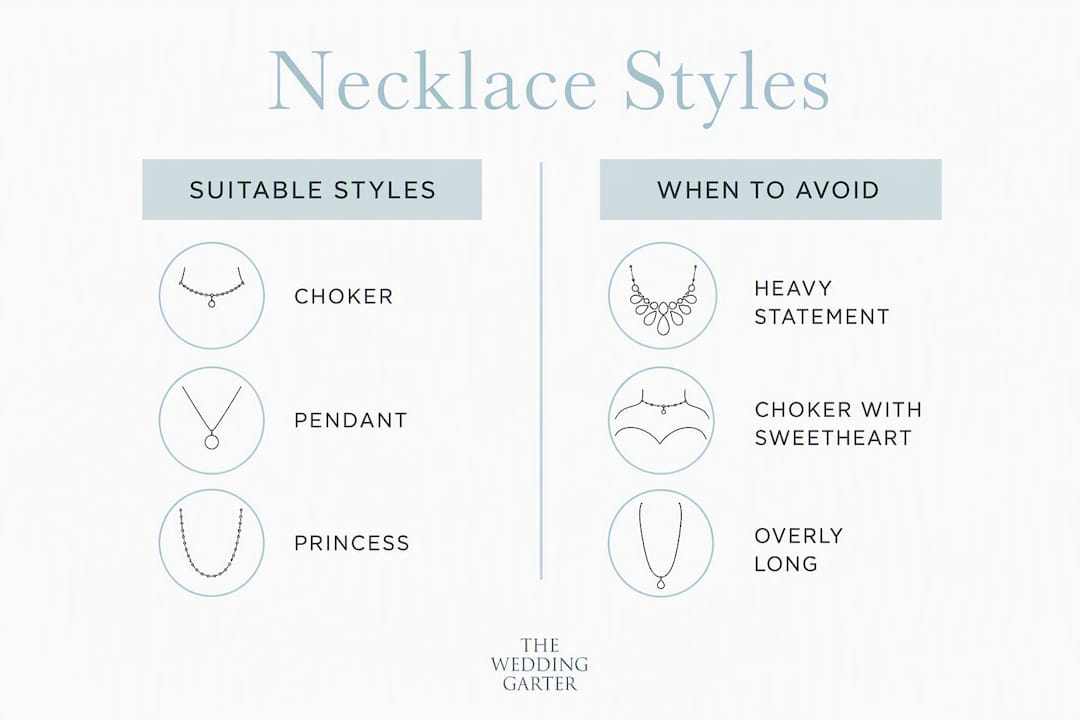
The necklace direction matters as much as the style. Straight-across necklines suit horizontal echoes like chokers or short collars, while sweetheart necklines suit pendants or layered chains that mirror the curve. Bib necklaces are reserved for the cleanest, most minimal gowns; pair one with a heavily beaded bodice and the result reads cluttered rather than considered.
How do you choose the right necklace for your dress?
Work through this checklist at your fitting before committing to any piece.
- Identify your neckline shape. Straight-across or sweetheart? The shape determines which styles are in play from the start.
- Assess bodice embellishment. Count the beading, lace, or embroidery. The more detail on the dress, the simpler the necklace should be.
- Check where the necklace sits. It must land clearly above the bodice edge, not on it. A piece that rests exactly at the fabric line can catch or shift during movement.
- Test comfort with movement. Raise your arms, sit down, lean forward. If the necklace flips, catches, or digs in, it is the wrong length or clasp style.
- Consider photo behaviour. Pendants that swing forward in candid shots can distract. Collars and chokers stay put.
- Match metal to your other accessories. Mixing gold and silver is acceptable when done deliberately; accidental mixing reads unfinished.
- Apply the balance rule. If you are unsure, default to simpler. You can always add; you cannot subtract on the day.
Pro Tip: Bring the actual dress, or a close mock-up, to any jewellery fitting. Trying a necklace over street clothes gives you no useful information about how it will sit on a structured strapless bodice.
For sweetheart necklines specifically, stylists advise against chokers because they visually shorten the neck. A pendant or layered piece that echoes the curve is the preferred choice.
Necklace length guide: what fits a strapless neckline?
Length is the most critical factor when choosing bridal jewellery for strapless gowns. The wrong length does not just look off; it can physically interfere with the dress.
| Length name | Inches | Centimetres | Visual effect on strapless | Caution |
|---|---|---|---|---|
| Choker | 14–16 in | — | Frames the collarbone; strong horizontal line | Avoid on sweetheart necklines |
| Princess | 16–18 in | 41–46 cm | Sits just below the collarbone; versatile | Check it clears the bodice edge |
| Matinee | 20–22 in | — | Falls mid-chest; suits open necklines | Can end exactly at bodice — test carefully |
| Opera / lariat | — | — | Dramatic drop; suits deep-V or low-back styles | Worn backward for back-drop effect |
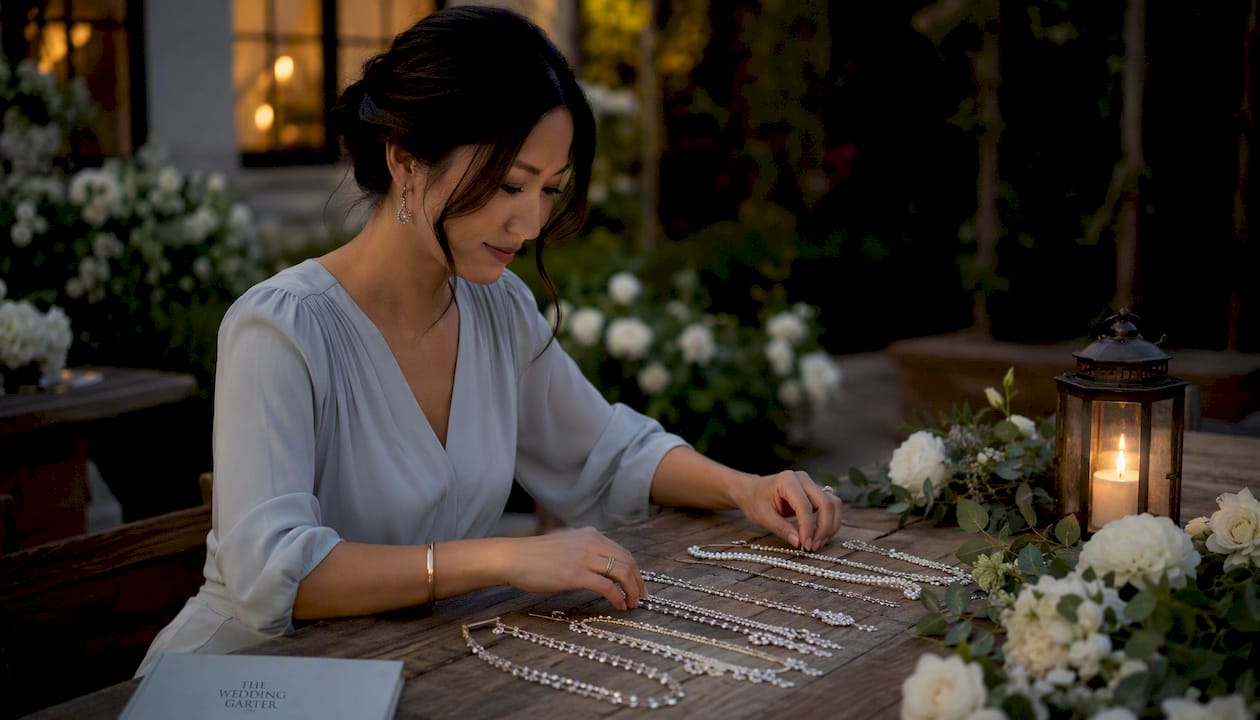
Common length guidance maps chokers at 14–16 in, princess at 16–18 in, and matinee at 20–22 in. The practical risk is a piece that ends exactly at the bodice edge; it can get caught in fabric or shift with every movement.
How to measure over the dress:
- Put on the full dress with the correct undergarments. A structured bridal bustier changes the bodice height, so wear it during the test.
- Hold the necklace at the intended length and check where it lands relative to the fabric edge.
- It should sit at least 1–2 cm above the bodice, or fall clearly below it.
- Fasten the clasp and move. Sit, stand, raise both arms. Note any catching or flipping.
How to pair your necklace with earrings and other accessories
The most common bridal accessorising mistake is pairing a statement necklace with statement earrings. Bridal guides consistently advise picking one statement piece and keeping everything else understated.
Dos:
- Pair a statement necklace or bib with small studs or simple diamond drops.
- Pair a delicate pendant with chandelier or drop earrings for balanced drama.
- Match metal tones across necklace, earrings, and bracelet for a cohesive finish.
- Consider veil height: a cathedral veil worn up can obscure a back-drop lariat; a blusher veil leaves the neck fully visible.
- If your hair is up, earrings become the focal point; keep the necklace secondary.
Don’ts:
- Never wear a statement necklace and statement earrings together; the face and neck become visually crowded.
- Avoid ultra-long necklaces that swing freely during dancing.
- Do not mix cool and warm metals unless the contrast is intentional and consistent.
For earring pairings by dress neckline, the general rule holds: the more prominent the necklace, the quieter the earring. Skin tone and metal colour also play a role. Warm undertones (golden, olive, or deep skin) tend to suit yellow gold and rose gold. Cool undertones (fair, pink, or blue-veined skin) generally complement white gold, silver, and platinum. This is a guide, not a rule; wear what you love, but test it in natural light before the day.
When should you skip the necklace altogether?
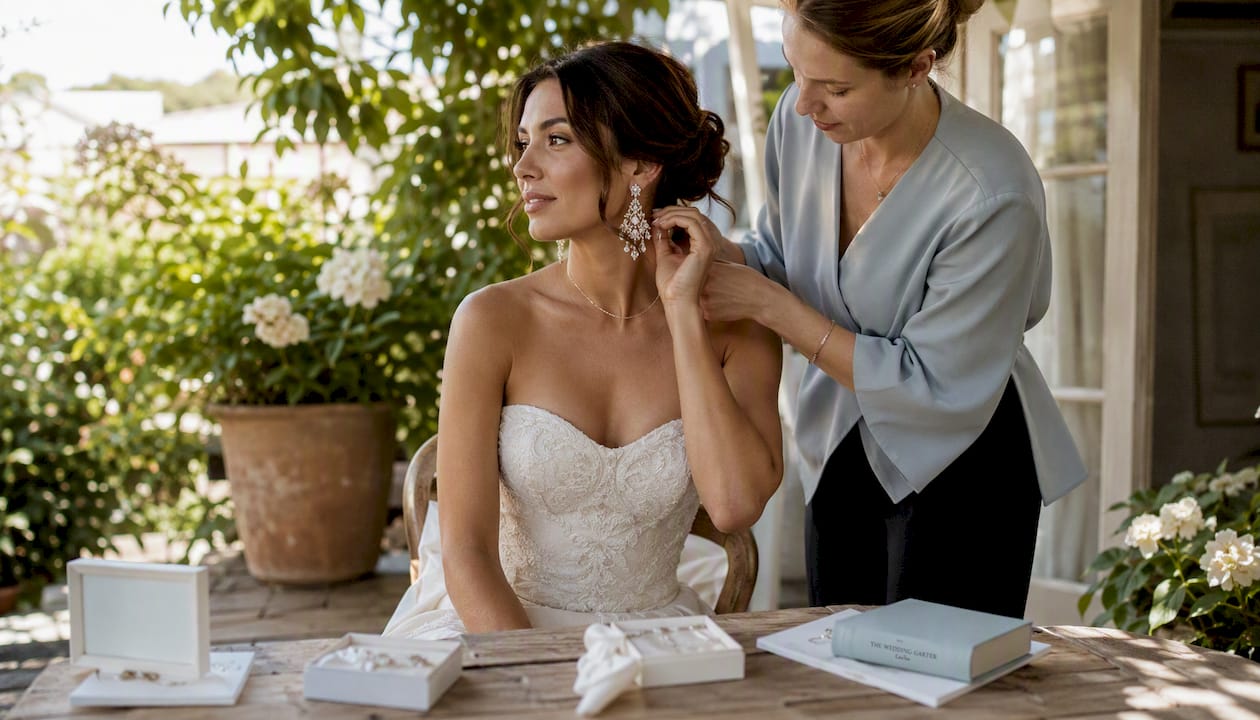
Sometimes the most polished choice is a bare neck. Stylists recommend this for heavily beaded, embroidered, or lace bodices where a necklace would compete rather than complement.
Elegant alternatives to a necklace:
- Statement earrings: chandelier or drop styles draw the eye upward without crowding the neckline. See statement earring options for strapless gowns.
- Hair combs or tiaras: add sparkle above the face and keep the décolletage clean.
- Back-drop lariat: worn in reverse so the decorative drop falls down the spine, this creates drama for low-back strapless gowns while the front profile stays minimal.
- Decorative veil attachment: a crystal or pearl-edged veil frames the face and adds movement without touching the neckline.
- Brooch: pinned to the bodice or bouquet, a vintage brooch adds personality without competing with the neckline.
Shop-ready picks from The Wedding Garter Australia
These pieces are available now and ship across Australia. Each is matched to a specific strapless neckline type.
- Vintage Art Deco Style Bridal Jewellery Set: a coordinated necklace and earring set; suits structured lace or corseted strapless gowns with a vintage aesthetic.
- Sterling Silver Cubic Zirconia Pendant Bridal Jewellery Set: a clean pendant set for sweetheart necklines; the silver tone suits cool undertones and modern minimal gowns.
- Charming Pearl & Diamond Pavé Pendant Bridal Necklace: a short pendant that sits just below the collarbone; ideal for straight-across strapless or sweetheart necklines on ballgowns.
- Pearl & CZ Diamond Luxury Pendant Bridal Necklace: a subtle, light-catching pendant for brides who want understated sparkle without a full set.
- Delicate Crystal Luxury Bridal Bracelet: pairs with any of the above necklaces to complete the wrist without competing with the neckline.
- Large Garden Design Ivory & Silver Bridal Headpiece: for brides skipping a necklace; this headpiece shifts the focal point upward and works beautifully with bare-neck strapless gowns.
- Classic Vintage Crystal Wedding Hair Accessories: a versatile hair accessory to balance a simple pendant or replace a necklace on an ornate gown.
- Delicate Crystal Luxury Bridal Hair Clip: a smaller adornment that adds sparkle near the face without touching the neckline at all.
Pro Tip: Always test your chosen necklace with the actual dress and the correct undergarments before the wedding day. A structured lace bustier raises the bodice line slightly, which can change where a princess-length piece sits.
Does your skin tone affect which metal to choose?
Yes, and it is worth thinking about before you shop. Metal colour interacts with skin undertone in ways that show clearly in photographs.
Warm undertones (golden, peachy, or olive skin) are generally flattered by yellow gold and rose gold. The warmth in the metal echoes the warmth in the skin, creating a harmonious finish. Cool undertones (fair skin with pink or blue veining) tend to suit white gold, sterling silver, and platinum. Neutral undertones have the most flexibility and can wear either well.
Beyond undertone, consider the dress itself. An ivory or champagne gown often reads better with gold or rose gold than with bright silver. A crisp white gown suits silver and white gold cleanly. These are tendencies, not absolutes. Test the piece against your skin in natural daylight and in the venue’s lighting if possible.
What necklace material holds up on a wedding day?
The wedding day is long. A necklace that looks perfect at 10 AM needs to still look perfect at midnight on the dance floor.
Sterling silver is the most common bridal choice: affordable, bright, and widely available. The drawback is tarnishing over time, particularly in humid conditions. For a one-day wear, this is rarely a problem, but store the piece properly before and after.
Gold-plated pieces offer the look of gold at a lower price point. The plating can wear at friction points over years of use, though for a single event this is not a concern. Solid gold (9ct or 18ct) is the most durable option and holds its finish indefinitely.
Cubic zirconia and crystal settings are the standard for bridal jewellery at most price points. They photograph beautifully and are far lighter than diamond alternatives. Check that stones are set securely; a loose prong on a pendant can mean a lost stone mid-reception.
For comfort, avoid heavy statement pieces if you are sensitive to weight at the neck. A lightweight crystal pendant on a fine chain is far more comfortable across a full wedding day than a substantial bib necklace, regardless of how good it looks in the mirror.
What should you budget for a bridal necklace?
Bridal necklace prices in Australia span a wide range depending on material, brand, and whether the piece is part of a set.
Crystal and cubic zirconia pendants and sets typically sit at the accessible end of the market, making them the most popular choice for brides who want sparkle without a significant outlay. Sterling silver pieces with CZ stones offer good durability and a clean finish at this tier.
Mid-range options include gold-plated sets, freshwater pearl strands, and coordinated jewellery sets that include matching earrings. These offer better longevity and a more polished presentation, and they are the sweet spot for most brides.
Fine jewellery, including solid gold or genuine diamond pieces, sits at the upper end. Some brides choose a single fine piece, such as a diamond pendant, and keep all other accessories simple. Others prefer to spend more on the dress and keep jewellery costs modest.
The most practical approach: set a combined jewellery budget (necklace, earrings, bracelet) rather than a per-piece budget. This prevents overspending on one item and leaving nothing for the rest of the look.
Key takeaways
The best necklace for a strapless wedding dress sits clearly above the bodice, matches the dress’s embellishment level, and is tested with the actual gown before the wedding day.
| Point | Details |
|---|---|
| Apply the balance rule | Match necklace boldness to dress embellishment; ornate gowns need simple jewellery. |
| Check necklace length | Choker 14–16 in, princess 16–18 in, matinee 20–22 in; never let it sit exactly at the bodice edge. |
| Test at a fitting | Wear the full dress and move; check for catching, flipping, or discomfort before the day. |
| Consider skipping a necklace | A bare neck with statement earrings or hair jewellery is often the most elegant choice for heavily embellished gowns. |
| The Wedding Garter Australia | Curated pendants, sets, and hair accessories for strapless gowns, available now with Australian shipping. |
Style rules are a starting point, not a finish line
The balance rule is genuinely useful. So is the advice about not pairing statement earrings with a statement necklace. But rules in bridal styling exist to be understood before they are broken, not followed blindly.
A bride who loves maximalist jewellery and has chosen a minimal column gown should wear the chandelier earrings and the layered necklace if that is what feels right. The goal is not to follow a checklist; it is to feel completely yourself on the day. Comfort and confidence photograph better than perfect adherence to any styling guide.
The one thing worth treating as non-negotiable: test the actual piece with the actual dress. Not a similar dress. Not street clothes. The real thing, with the correct undergarments and shoes, in movement. That single step eliminates most of the practical problems brides encounter with necklace fit on the day.
Bridal jewellery for strapless gowns, curated and ready to ship
The Wedding Garter Australia has put together a focused collection of pendants, jewellery sets, and hair accessories chosen specifically for strapless and sweetheart necklines. Every piece ships across Australia, and the range covers everything from a clean crystal pendant for a minimal gown to a full Vintage Art Deco Style Bridal Jewellery Set for brides who want a coordinated vintage look.
If you are working with a heavily embellished gown and want to skip the necklace, the hair accessory range includes headpieces, crystal clips, and vintage combs that shift the focal point beautifully. Gift wrapping is available, and the team is on hand for styling questions. Browse the full bridal jewellery collection at theweddinggarter.com.au and find the piece that fits your gown, your neckline, and your day.
Useful sources
- The Knot: Necklace for strapless wedding dress
- Emmaline Bride: Jewellery for strapless dress
- Emmaline Bride: Wedding jewellery sets for strapless dress
- Atolea Jewelry: Jewellery for strapless dress
- Lovella Bridal: Best bridal necklace for strapless ballgown
- Artizan Joyeria: Best necklaces for strapless dress
- Jewelers Mutual (Ode1): Jewellery to wear with strapless dress
- Robinson’s Jewelers: How to choose a necklace for a strapless dress
- The Wedding Garter Australia: Jewellery for sweetheart necklines
- The Wedding Garter Australia: Best bridal earrings for every neckline
FAQ
What kind of necklace should you wear with a strapless wedding dress?
A short pendant or princess-length necklace (16–18 in / 41–46 cm) suits most strapless gowns. The key is to ensure it sits clearly above the bodice edge and matches the embellishment level of the dress.
What jewellery works best with a sweetheart neckline?
For a sweetheart neckline, a pendant or layered necklace that echoes the curve is the preferred choice; avoid chokers, which can visually shorten the neck on this neckline shape.
Should you wear a necklace with a heavily beaded strapless dress?
Often, no. A bare neck with statement earrings or hair jewellery is frequently the most elegant choice for heavily embellished or lace bodices, where a necklace would compete with the dress detail rather than complement it.
How do you accessorise a strapless dress for a wedding without over-doing it?
Pick one statement piece, either a necklace or earrings, and keep the other simple. Match metal tones across all pieces, test everything with the actual dress at a fitting, and consider hair jewellery or a back-drop lariat as alternatives to a front-facing necklace.
Recommended
- Best Bridal Jewellery for a VNeck Gown: The Ultimate 2026 Style Guide – The Wedding Garter
- What Jewellery to Wear With a Sweetheart Neckline Wedding Dress: Your – The Wedding Garter
- The Best Bridal Earrings Style For Every Dress Neckline - The – The Wedding Garter
- What to Wear Under a Form-Fitting Wedding Dress: Your Flawless Guide f – The Wedding Garter


Leave a comment