

The best fabrics for bridal lingerie, explained by dress type
Silk and satin remain the top choice for photo-ready bridal lingerie, but they’re not the whole story. For seamless wear under sheer or fitted gowns, a polyamide-elastane microfibre or tonal power mesh does the job silk cannot: it disappears. For all-day support without a visible line, look to power mesh, powernet, or a high-recovery nylon-spandex knit like milliskin.
There is no single “best” fabric. There’s a best fabric for each job.
- Photo-ready, getting-ready sets: silk charmeuse or satin, for the sheen and drape that photographs beautifully.
- Under sheer or illusion gowns: polyamide-elastane microfibre or tonal power mesh, chosen to match skin tone so nothing shadows through.
- Structured support (bustiers, underwire pieces): power mesh, powernet, or high-recovery nylon-spandex blends that hold shape through a long reception.
- Honeymoon and wedding-night pieces: lace, chiffon, or satin, prioritising feel and visual impact over invisibility.
Whatever you pick, the wedding dress itself has the final vote. Its fabric, cut, and lining dictate what will vanish underneath it and what will fight it for attention. A bias-cut silk slip gown behaves nothing like a structured mikado ball gown, and the lingerie fabric that works under one will ruin the line of the other.
Key Takeaways
The right bridal lingerie fabric depends on the dress, not personal preference: match power mesh and microfibre to structure and invisibility, and reserve silk and lace for visual impact.
| Point | Details |
|---|---|
| Dress dictates fabric | Choose lingerie fabric based on your gown’s cut and lining before considering style or price. |
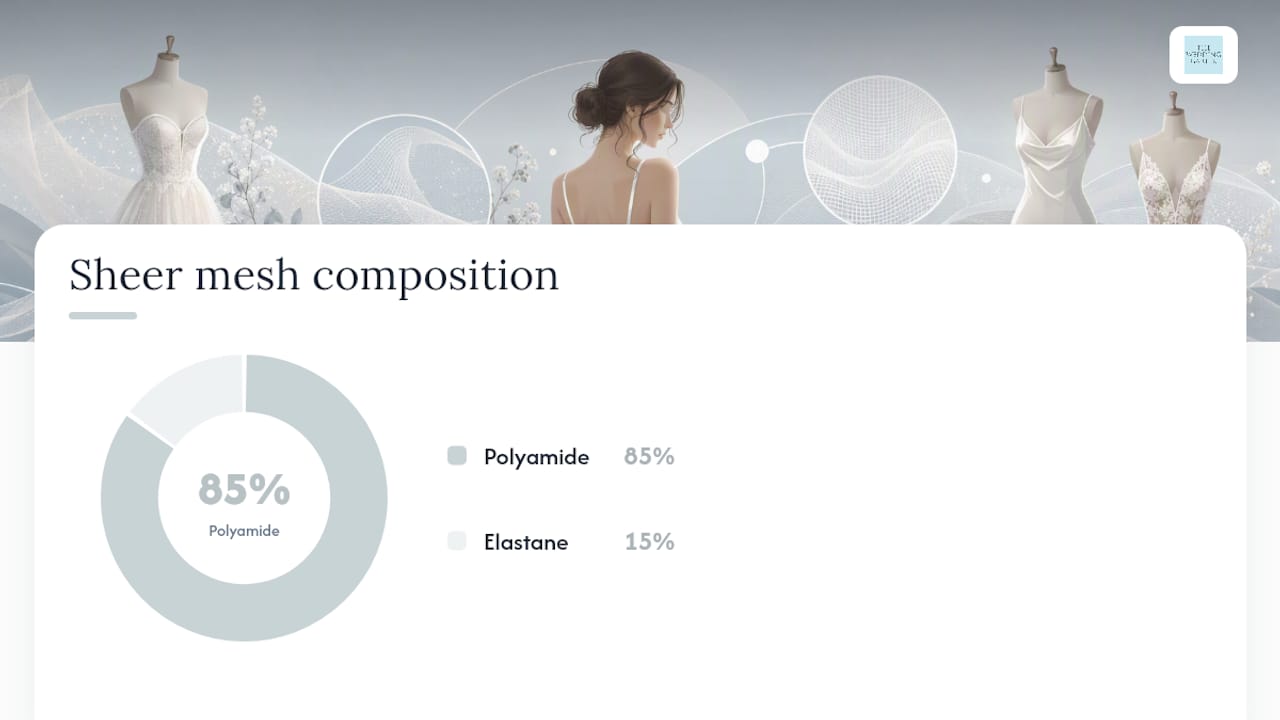
| Composition ranges matter | For sheer mesh, look for roughly 85% polyamide with 15% or less elastane for lasting stretch and recovery. |
| Seams decide invisibility | Bonded or flatlock seams sit flush under fitted gowns; standard overlocked seams don’t. |
| Swatch before you buy | Always request a physical swatch and check it against your gown in natural daylight. |
| The Wedding Garter offers tested pieces | Structured bustiers and chemises from The Wedding Garter already balance sheer lace with power-mesh support. |
Table of Contents
- Understanding bridal lingerie fabrics: the core types and where each one works
- What fabric properties actually matter for a wedding day?
- Which fabrics suit your dress silhouette?
- Where to buy bridal lingerie fabric and what to ask suppliers
- Construction choices that make lingerie invisible and durable
- How do you match lingerie colour to your gown?
- Caring for delicate bridal lingerie fabrics before the wedding
- Quick shopping checklist for bridal lingerie fabric
- What tests do designers actually run on bridal fabric?
- Natural versus synthetic: what actually changes for the bride
- Environmental and ethical considerations in bridal fabric choices
- What does bridal lingerie fabric actually cost?
- An editor’s take: fit first, comfort second, photographs third
- Ready to shop bridal lingerie fabrics that actually perform?
- Sources
- FAQ
Understanding bridal lingerie fabrics: the core types and where each one works
Before comparing options side by side, it helps to know what you’re actually looking at on a fabric bolt or a product label. Bridal lingerie draws from a smaller pool of materials than eveningwear, mostly because comfort and invisibility carry more weight than pure decoration.
Silk (habotai or charmeuse weight) is the benchmark for luxury. Habotai is lightweight and slightly matte; charmeuse has the liquid sheen brides picture when they imagine a slip. Neither offers structural support on its own, and both need careful handling, but nothing else feels quite the same against skin.
Satin, whether silk-faced or polyester, gives you that same lustrous surface at a lower price and with far better durability. It’s the fabric behind most garters and many getting-ready robes, largely because it holds its sheen through travel and photography without the fragility of pure silk.
Chiffon floats. It has almost no structure, which makes it wrong for support pieces but ideal for layering over a bodysuit or adding movement to a robe or peignoir.
Lace does more design work than any other bridal fabric. Chantilly lace is fine, delicate, and best suited to fitted silhouettes where you want pattern without bulk. Alençon lace is heavier and corded, giving it more presence for fuller skirts and structured bustiers. Modern laces are engineered to be considerably softer and more wearable against skin than the stiff vintage versions many people picture, which is part of why lightweight Chantilly styles now sit comfortably under fitted gowns while heavier laces are reserved for fuller silhouettes.
Tulle and mesh cover a wide range, from stiff tulle (mostly decorative, used in overlays) to soft power mesh (a workhorse for support panels and sheer inserts). Stretch lace and nylon stretch fabrics sit in this category too, giving designers a way to combine pattern with genuine give and recovery.
Organza is crisp, sheer, and almost entirely decorative. It shows up in trims and overlays, never as a base fabric for anything load-bearing.
Power mesh and powernet are the unsung heroes of structured bridal lingerie. These synthetic knits hold their shape under tension far better than lace or satin, which is why bustiers and shapewear-style pieces lean on them for the actual support, dressing the outside with lace or embroidery.
Microfibre and micro-modal are the invisibility specialists. Fine-denier, soft, and often brushed for comfort, they’re the fabric of choice when a brief or slip needs to disappear entirely.
Milliskin and nylon-spandex tricot round out the list. Typical blends run around 76% nylon to 24% spandex, delivering four-way stretch and a luminous, slightly reflective face that suits both structured pieces and honeymoon sets.
| Fabric | Appearance | Support | Opacity | Stretch/recovery | Drape/weight | Breathability | Best use | Cost tier |
|---|---|---|---|---|---|---|---|---|
| Silk charmeuse | High sheen, liquid drape | Low | Opaque | Minimal | Light, fluid | High | Getting-ready sets, slips | High |
| Satin (poly) | Glossy, smooth | Low | Opaque | Minimal | Medium | Moderate | Garters, robes | Low to mid |
| Chiffon | Sheer, floaty | None | Sheer | Minimal | Very light | High | Robes, overlays | Low to mid |
| Chantilly lace | Fine, patterned | Low | Semi-sheer | Slight (with base) | Light | Moderate | Fitted bodices | Mid to high |
| Power mesh | Matte, smooth knit | High | Sheer to semi-opaque | High | Medium | High | Bustiers, panels | Low to mid |
| Microfibre | Soft, matte | Medium | Opaque to semi-opaque | Moderate to high | Light | High | Seamless briefs | Mid |
| Milliskin/tricot | Satin-like sheen | Medium to high | Opaque | Very high | Medium | Moderate | Honeymoon sets, bodysuits | Low to mid |
If you’re buying a getting-ready set, prioritise silk or satin. If you need a bustier that survives a ten-hour reception, prioritise power mesh with lace as the visual layer, not the structural one. For seamless briefs under a fitted gown, microfibre wins every time.
What fabric properties actually matter for a wedding day?
Reading a fabric composition label properly saves you from an expensive mistake. Two fabrics can look identical on a swatch card and behave completely differently after six hours of wear.
Stretch versus recovery is the distinction most buyers miss. Stretch is how far a fabric extends; recovery is whether it bounces back to its original shape afterward. A fabric can have huge stretch and terrible recovery, which means it looks fine in the fitting room and sags by the reception. For sheer bridal mesh specifically, industry guidance points toward compositions of roughly 85% polyamide or more paired with 15% elastane or less as a workable balance between stretch and shape retention across a full day.
Opacity and weight (GSM) determine whether a fabric shows through a light-coloured gown. A low-GSM microfibre in a tonal shade will vanish under an ivory sheath. The same fabric in white under a champagne gown will read as a visible patch, regardless of how sheer or expensive it is.
Drape and hand affect how the fabric sits against skin and whether it clings, floats, or holds its own shape. Softer hand fabrics feel better for hours of wear; stiffer ones hold decorative shapes but can dig in.
Breathability matters more than most brides expect. A reception can run long, under lights, on a dance floor. Synthetic blends with poor breathability trap heat; better microfibres and mesh are engineered with more airflow.
Seam and edge finishes on the finished garment matter as much as the fabric itself. Flatlock seams and bonded seams sit flush against skin and don’t show through fitted fabric. Laser-cut edges eliminate hems entirely, which is why so many modern seamless briefs use them.
A quick composition checklist before you buy:
- Check the polyamide-to-elastane ratio on sheer mesh (aim for the 85/15 range as a starting point).
- Confirm GSM or weight if it’s listed, and ask if it isn’t.
- Ask whether seams are bonded, flatlocked, or serged.
- Request the care label wording before you buy, not after.
Pro Tip: Test stretch and recovery at home before committing to a metre of fabric: measure a 10cm section unstretched, pull it to its comfortable maximum, then let it rest for a minute and measure again. If it doesn’t return within a centimetre or two of the original 10cm, its recovery is poor and it will sag with wear.
Which fabrics suit your dress silhouette?
The dress dictates the lingerie, not the other way around. A fabric that’s perfect under one silhouette can be a disaster under another.
Bias-cut silk gowns are unforgiving. Every seam, waistband, and lace edge shows through the fabric’s cling, so the only sensible choice is a tonal, seamless microfibre brief with laser-cut edges and no visible elastic. Anything with a decorative edge will print through the silk.
Chiffon-float dresses are more forgiving because the fabric itself has volume and movement, giving lingerie more room to hide. A power-mesh bustier with a lace overlay works well here, since the chiffon’s own drape disguises minor seam lines.
Fitted crepe and mikado gowns are structured and close to the body, which means support has to come from the lingerie, not the dress. This is where power mesh and powernet earn their keep, ideally with bonded seams and internal strap channels rather than surface-stitched straps.
Illusion-lace backs are the trickiest case in bridal dressing. Anything worn underneath is visible through the lace, so the lingerie fabric becomes part of the dress’s visual design rather than something hidden. A tonal, low-profile bra in a shade matched precisely to the illusion mesh, or a well-fitted bodysuit in the same family of tone, tends to work better than white.
Low-back dresses simply rule out most traditional bra constructions and push buyers toward adhesive cups, convertible straps, or bodysuits with low-back panels in stretch mesh.
| Dress type | Recommended lingerie fabric | Construction notes |
|---|---|---|
| Bias-cut silk slip gown | Tonal microfibre, laser-cut edges | No visible seams or elastic; match skin tone closely |
| Chiffon-float gown | Power mesh bustier, lace overlay | Chiffon’s drape hides minor seam lines |
| Fitted crepe/mikado | Power mesh, powernet, bonded seams | Internal strap channels over surface stitching |
| Illusion-lace back | Tonal mesh or bodysuit, colour-matched | Treat lingerie as visible design, not a hidden layer |
| Low-back gown | Stretch mesh bodysuit, adhesive cups | Standard bra backs are structurally ruled out |
A lace chemise works beautifully under a structured ball gown where nothing shows through the skirt, but the same piece under a bias-cut silk slip will print every seam. Match the fabric decision to the dress, not to what looks best on a hanger.
Where to buy bridal lingerie fabric and what to ask suppliers
Sourcing splits into three broad channels, each suited to a different kind of buyer.
Fabric mills and online fabric yards suit dressmakers and hobby sewists building custom pieces from scratch. This is where you’ll find raw yardage of power mesh, microfibre, and milliskin, usually sold by the metre with minimums that vary supplier to supplier.
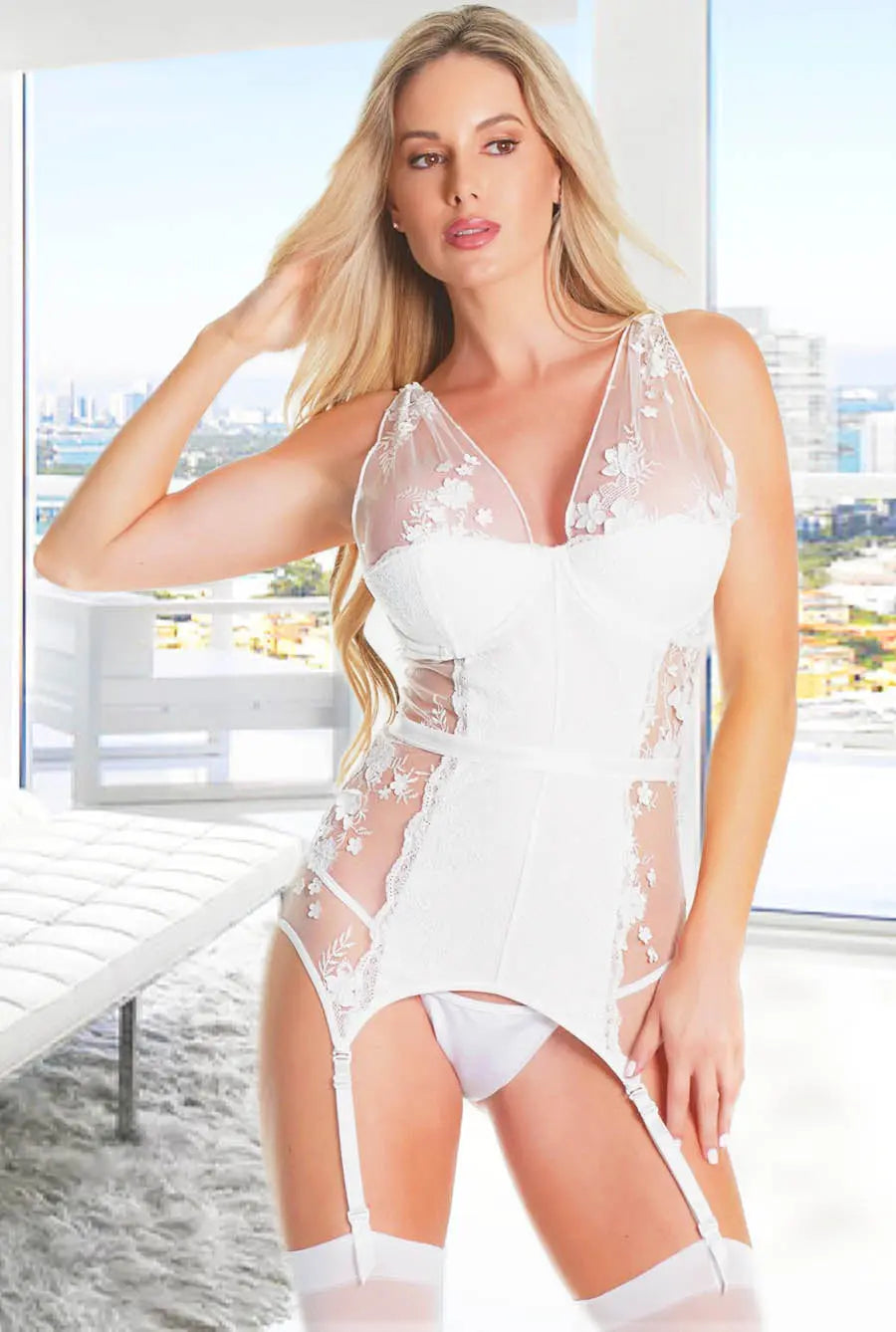
Bridal lingerie retailers, including The Wedding Garter, suit buyers who want a finished, tested piece rather than a sewing project. A Romantic Lace Underwire Bridal Bustier or a Delicate Sheer Lace Bridal Bustier has already had the fabric, seam, and support decisions made by someone who’s tested them.
Wholesale lace suppliers specialise in one thing: decorative fabric by the roll, usually for makers who need consistent lace across multiple garments or a full bridal party.
When you request swatches, ask for more than a colour reference. A short message template:
- Request physical swatches, not digital photos, of the exact dye lot you’d be buying.
- Ask for the fibre composition and stretch percentage in writing.
- Ask whether the dye lot is guaranteed consistent if you need multiple metres.
- Confirm minimum order quantities and lead time before committing.
- Request a small seam sample if the piece is finished, not raw yardage.
How much fabric you actually need depends heavily on the garment:
Order swatches in natural daylight, not under shop lighting, and keep every dye lot number if you’re buying fabric for a multi-piece set. A mismatched dye lot between a bra and matching brief is one of the most common and most avoidable mistakes in custom bridal lingerie.
Construction choices that make lingerie invisible and durable
Fabric choice only gets you halfway. How the garment is put together decides whether it survives a full wedding day and whether it shows under the dress.
Seam finish matters most. Bonded seams and flatlock stitching sit almost flush against the skin, which means no ridge printing through fitted fabric. Standard overlocked seams are fine for a robe or getting-ready piece where nothing sits over them, but wrong for anything worn under a bias-cut gown.
Underwiring adds shape but also adds a visible edge under thin fabric. Where wire is genuinely needed for support, it should be fully encased and positioned so the channel doesn’t sit directly under a seam line in the dress.
Power-mesh reinforcement panels, placed at the sides and back of a bustier, do the actual holding while lace or embroidery does the decoration. This is the split that separates a piece that looks pretty from one that lasts through dancing.
Strap anchoring is an underrated failure point. Bar-tacked loops and internal channels distribute weight far better than a strap simply stitched to the fabric’s surface, which stretches and eventually tears under repeated pull.
Laser-cut edges eliminate hemming altogether, giving a completely flat, invisible finish, particularly valuable on briefs and bodysuit legs.
Lining choices need care too. Cotton lining feels lovely against skin, but in seam-critical zones, its bulk and lack of stretch will fight against a power-mesh or microfibre outer layer, creating exactly the ridge you’re trying to avoid.
A quick construction checklist for makers or bespoke buyers:
- Confirm seam finish (bonded or flatlock, not standard overlock, for anything worn under fitted fabric).
- Check underwire is fully encased and positioned away from dress seam lines.
- Look for reinforcement panels at stress points on structured pieces.
- Ask how straps are anchored, not just how they’re styled.
- Avoid cotton lining in areas that need to stay flat and stretch with the body.
Pro Tip: Test strap anchoring before the big day with a simple pull test: gently but firmly pull each strap at the anchor point for several seconds. If you see any stretching, popping, or thread give, that anchor won’t survive a full day of movement and dancing.
For pieces like the Delicate Sheer Lace Bridal Bustier, the sheer lace is doing the visual work while a power-mesh understructure does the actual supporting, which is exactly the split you should look for in any structured piece.
How do you match lingerie colour to your gown?
Colour mismatch is one of the most common and most preventable bridal lingerie mistakes, largely because screens lie. What looks like a perfect ivory match on your phone can read as a jarring contrast in daylight, because true ivory, cool white, and champagne all photograph differently depending on screen calibration and lighting.
A reliable swatch test takes four steps:
- Request a physical fabric swatch from the supplier rather than trusting a product photo.
- Check the swatch against your gown, or a swatch of your gown fabric, in natural daylight near a window, not under indoor lighting.
- Drape the lingerie swatch under a scrap of your actual gown lining and hold both up to the light to check for mottling or shadowing.
- Photograph both together in soft daylight to see how they’ll actually appear in wedding photos.
A perfect colour match matters most under light-coloured, sheer, or illusion gowns, where any tonal gap between skin, lingerie, and dress reads as a visible patch. It matters far less under deep-toned or heavily structured gowns, where the lingerie is fully hidden regardless of shade.
- Ivory, soft white, and blush tend to work better under most bridal gowns than stark white or an unresearched “nude,” which buyer guidance consistently recommends for genuinely bridal-appropriate transparency.
- Designers prioritise tone-matching to skin and gown lining over generic nude shades, specifically to avoid the visible “patch” effect under sheer panels.
- If you’re shooting getting-ready photos, a glam photo booth guide on lighting for bridal prep is worth a look, since the same daylight principles that make a swatch test accurate also make photos look their best.
Caring for delicate bridal lingerie fabrics before the wedding
Silk and fine lace need hand-washing in cool water with a gentle detergent, laid flat to dry rather than hung, since wet silk stretches under its own weight. Delicate embellished pieces, particularly anything with beading or embroidery, are safest sent to a professional dry cleaner experienced with bridal wear.
Synthetic power mesh, microfibre, and milliskin are more forgiving. Most can go through a cold machine wash on a gentle cycle inside a mesh laundry bag, though you should always check the specific care label, since finishes and linings vary between suppliers.
Pressing needs care too. Satin and silk scorch easily, so a cool iron with a pressing cloth, or steam from a distance, is safer than direct heat.
For destination weddings or anything travelling in a suitcase, pack lingerie flat between layers of acid-free tissue paper, never folded on top of heavier items. Beaded or embroidered pieces should be wrapped separately so hardware doesn’t snag delicate lace nearby.
A short packing checklist for your bridal box:
- Layer silk and lace flat with acid-free tissue, not folded.
- Wrap beaded or embroidered pieces separately to prevent snagging.
- Pack structured pieces (bustiers) in a rigid box, not squashed into a suitcase corner.
- Bring a small emergency kit: safety pins, a lint roller, and a spare pair of tights or seamless briefs.
Quick shopping checklist for bridal lingerie fabric
Print this before you shop, whether you’re buying fabric by the metre or ordering a finished piece.
- Request a physical swatch, not a digital photo, in the exact dye lot.
- Check the fibre composition and stretch/recovery percentage in writing.
- Confirm seam finish (bonded, flatlock, or standard) before you buy a finished garment.
- Match colour and dye lot across every piece in a multi-item set.
- Calculate how much fabric you need using garment-specific yardage, not a rough guess.
- Confirm shipping lead time against your wedding date, with buffer for reorders.
What tests do designers actually run on bridal fabric?
Beyond a basic hand-feel check, a few practical tests separate fabric that looks right from fabric that performs on the day.
- Stretch and recovery measurement. Stretch a marked section to its comfortable maximum, release, and measure the return after 60 seconds. Poor recovery shows up immediately as a fabric that doesn’t fully spring back.
- Light-drape test. Hold the fabric against a strong light source to check true opacity, not just how it looks under normal room lighting.
- Seam-visibility test under gown lining. Drape a scrap of the actual gown lining over the lingerie sample and check under natural light for mottling, shadowing, or an unwanted contrast line, exactly the check designers use before signing off on a fabric pairing.
- Strap anchoring pull test. Apply firm, sustained pressure to each strap anchor point and watch for stretching or thread give.
- Wear-time recovery test. Wear the piece, or a sample, for six or more continuous hours and check whether elastic and mesh panels have lost meaningful recovery by the end.
For sheer bridal mesh, the composition guideline of roughly 85% polyamide with 15% or less elastane is the benchmark worth checking against before you commit to a fabric for a full-day piece. A fabric that fails the six-hour recovery test isn’t necessarily unusable. It may simply belong in a photo-only piece, worn for an hour of portraits rather than a full reception.
Natural versus synthetic: what actually changes for the bride
Natural fibres like silk win on feel and breathability but lose on shape retention and durability. Silk has almost no stretch, which means it can’t hold a fitted line on its own. It also creases, water-marks, and demands careful cleaning, all trade-offs brides accept for the way it feels and photographs.
Synthetic fibres, mainly nylon, polyamide, and elastane blends, win on structure, recovery, and resilience. Power mesh, milliskin, and microfibre hold their shape through hours of wear, survive machine washing, and cost less per metre. What they trade away is some breathability and that distinct organic hand-feel silk has.
In practice, most well-made bridal lingerie blends the two. Lace, often nylon-based itself, provides the decorative layer, while a synthetic power-mesh or microfibre understructure does the actual supporting. A structured piece built entirely from silk would sag within an hour; one built entirely from synthetic mesh would miss the visual softness brides want in their photos.
Environmental and ethical considerations in bridal fabric choices
Silk production is resource-intensive, and conventional silk farming raises ethical questions for some buyers around silkworm treatment, which has pushed demand toward peace silk and other lower-impact alternatives. Synthetic fabrics like nylon and polyester avoid those specific concerns but come with their own footprint, since they’re petroleum-derived and shed microplastics during washing.
Neither option is free of trade-offs, which means the more useful question for most brides isn’t “natural or synthetic” but “how much of this will I actually keep wearing.” A well-made lace chemise or robe often gets a second life well beyond the wedding day, unlike single-use decorative pieces bought for one photo. Buying fewer, better-made pieces, and caring for them properly so they last, does more for reducing overall impact than chasing a specific fibre label.
Some suppliers are more transparent than others about sourcing, and it’s reasonable to ask a fabric mill or retailer directly about origin and dyeing processes if that matters to your decision. That transparency is worth asking about regardless of which fabric family you land on.
What does bridal lingerie fabric actually cost?
Price in bridal lingerie tracks construction quality more closely than it tracks the raw fabric itself. A mid-tier piece often delivers most of the performance of a premium one, because the meaningful cost differences sit in bonded seams, lace density, and hardware quality, not in the sheer percentage of a mesh panel.
At the low end, polyester satin and basic power mesh keep costs down and suit garters, simple briefs, and everyday-style getting-ready sets. Mid-tier pieces bring in better-density lace, bonded seams, and higher-recovery synthetic blends, the range where most structured bustiers and bodysuits sit. At the premium end, silk charmeuse, corded Alençon lace, and fully boned bustiers with hand-finished seams command the highest prices, reflecting both fabric cost and labour.
If your budget is tight, spend on construction (seams, boning, strap anchoring) before you spend on fabric grade. A beautifully finished piece in mid-tier mesh will outlast and outperform a poorly constructed one in premium silk.
An editor’s take: fit first, comfort second, photographs third
Get the priority order wrong and everything else you decide about fabric becomes guesswork. Dress fit comes first, always. If a fabric fights the line of the gown, no amount of luxury or cost saves it. That’s not a rule to break for a piece you love on the hanger.
Comfort comes second, and it’s chronically underweighted in how bridal lingerie gets marketed. A bride wears these pieces for twelve or more hours, through a ceremony, photos, a reception, and dancing. Fabric that looks stunning in a fitting room but chafes or loses recovery by hour six was the wrong choice, regardless of how it photographed in the shop mirror.
Photographs come third, not first, which is the opposite of how most bridal shopping decisions get made. Chase the visual only after fit and comfort are settled, not before. A Delicate Sheer Lace Bridal Bustier or a lace chemise earns its place in a wardrobe because the underlying construction, the power-mesh support, the bonded seams, the strap anchoring, holds up all day. The lace is what you see in photos. The mesh underneath is what actually gets you through the day.
Ready to shop bridal lingerie fabrics that actually perform?
Reading fabric labels and testing stretch and recovery at home takes time most brides don’t have in the final months before a wedding. The Wedding Garter Australia’s advantage is simple: every piece has already been through the fabric and construction decisions covered in this guide, so you’re choosing between tested, finished garments rather than gambling on a metre of unfamiliar mesh.
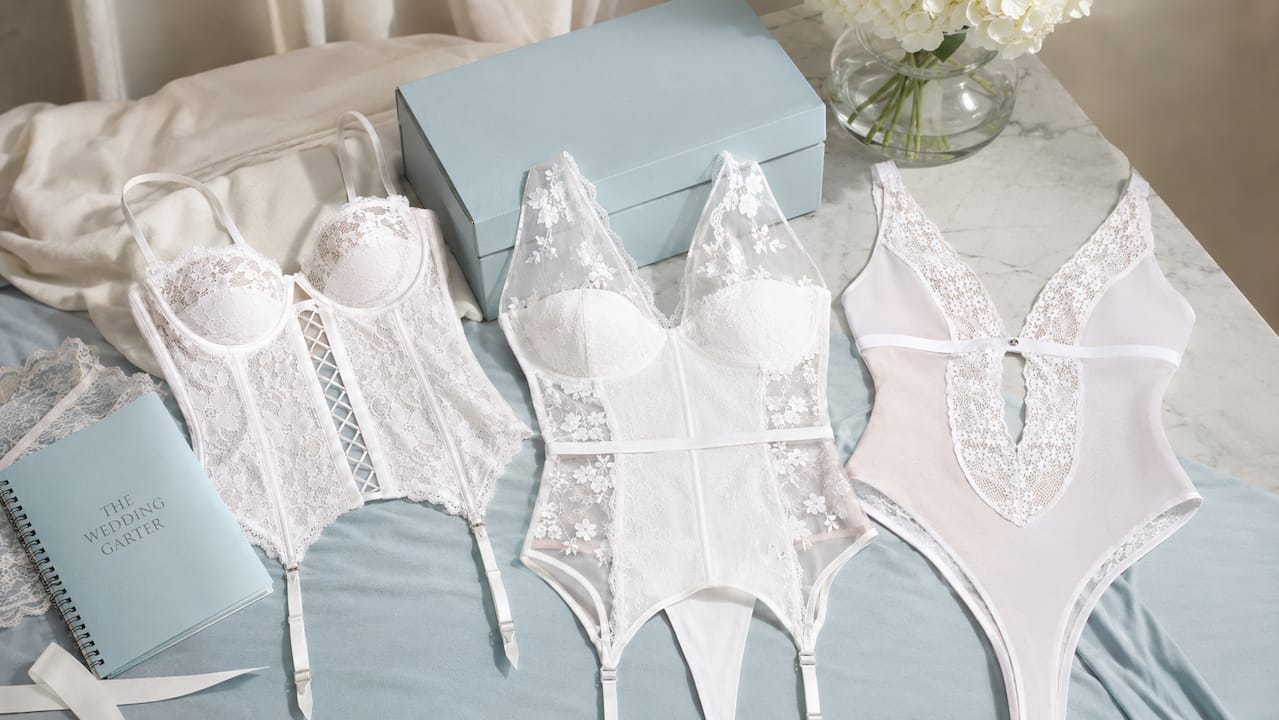
Our range spans exactly the trade-offs this guide walks through, from the Luxury White Lace Lingerie Chemise built for getting-ready photos, to the Romantic Lace Underwire Bridal Bustier for all-day structural support, to the Sexy Sheer Lace & Mesh White Bridal Underwear Set for brides after tonal, bridal-appropriate transparency. If you’re building out a full bridal set, pair any of these with a Satin Bridal Garter or a Vintage Art Deco Style Bridal Jewellery Set for a finished look. Browse the collection and check sizing and colour options against your gown before your fitting.
Sources
- How to Choose Sexy Bridal Transparent Lingerie — A Realistic Guide
- Beyond Basic White: 7 wedding lingerie styles that will change your wedding day — Wezoree
- Geometric lace fabric - nylon stretch for bridal lingerie — WeaveSource
- Cream Spandex Fabric by the Yard | Shiny Milliskin Nylon Spandex Fabric — Gala Textile
FAQ
What are the best undergarments for a wedding dress?
The best choice depends on your gown’s fabric and cut, but a seamless microfibre brief or bodysuit works under most fitted or sheer gowns, while a power-mesh bustier suits structured ball gowns needing extra support.
What fabric is best for bridal lingerie under a sheer gown?
Tonal polyamide-elastane microfibre or power mesh, matched closely to skin tone, disappears best under sheer or illusion fabric, since white or generically “nude” shades often create a visible contrast.
How much stretch should bridal lingerie fabric have?
For sheer mesh, a composition of around 85% polyamide with 15% or less elastane is a reasonable benchmark for balancing all-day stretch with shape recovery.
Should I choose silk or synthetic fabric for wedding-night lingerie?
Silk offers unmatched feel and sheen for wedding-night pieces, while synthetic blends like milliskin offer more stretch, easier care, and better durability. Many brides choose based on which piece feels right for the occasion.
Where can I buy tested bridal lingerie without sewing my own?
Bridal-focused retailers like The Wedding Garter Australia sell finished, ready-to-wear pieces such as lace bustiers and chemises where the fabric and construction decisions have already been made and tested.
How do I know if my lingerie will show through my dress?
Drape a scrap of your actual gown lining over the lingerie sample and hold both up to natural light. Any mottling, shadowing, or contrast means it will likely show through on the day.


